
Each insurance payer has its formatting rules, edit logic, and routing IDs for electronic claims submission. These unique requirements make billing one of the most error-prone parts of revenue cycle management (RCM).
Therefore, professionals prefer relying on a medical billing clearinghouse to ease this task. But what is a clearinghouse, and what purpose does it serve?
The easiest way to explain it is to consider it as a secure, HIPAA-regulated middleman sitting between practice management systems and insurance payers. These payers can be:
Commercial insurance companies such as:
Healthcare clearinghouses are one of the three types of HIPAA-covered entities (along with health plans and healthcare providers), as defined under 45 CFR 160.103.
Unfortunately, some practices may still consider them a black box. If you’re wondering what a clearinghouse in medical billing does and its significance for physicians and in-house billing teams, this guide is for you.
We will also discuss what makes a reliable clearinghouse and the best practices to choose one.
Digging Deeper Into It
Before discussing the importance of a clearinghouse for healthcare providers, let’s dive deeper into clearinghouses and their role.
A section in the HIPAA Administrative Simplification Regulations defines a healthcare clearinghouse as:
A public or private entity that converts nonstandard health information into standard transactions, or vice versa, for a receiving entity.
This may be in the form of:
- Billing services
- Repricing companies
- “Value-added” networks and switches
In simpler words, the clearinghouse reviews the billing format your software produces and converts it into a standardized format for claim processing.
Note: Clearinghouses are specifically defined under HIPAA as entities performing translation between standard and nonstandard transactions.
Medical billing clearinghouses convert claims into the HIPAA-mandated 837 transaction format for electronic submission to payers.
However, three different variants of this claim format may be used, which are as follows:
Quick Insight: The medical billing team should know that Medicare mandates partners perform file exchange via ASC X12 Version 5010, adopted by the Department of Health and Human Services (HHS).
Importance of Clearinghouse for Healthcare Providers
A clearinghouse in healthcare is more than just convenience. In fact, it is necessary for any practice with multiple digital payers.
Under the Administrative Simplification Compliance Act (ASCA), Medicare claims must generally be submitted electronically unless a valid exception applies. For instance, if the provider is eligible for a particular waiver or exception, then paper-based submissions will be accepted.
Moreover, commercial and government payers have similar expectations, which makes clearinghouse digital submission the go-to or default for the latest practices.
Key Benefits of Clearinghouses for Healthcare Providers
Clearinghouses play a vital role in healthcare operations. The following is a breakdown of some of the most common ones.
Multiple Connection Coverage
Maintaining several electronic data interchange (EDI) connections and login details is a nuisance. Similarly, adhering to payer-specific companion guide requirements adds complexity. Therefore, clearinghouses handle each claim and direct it to the suitable payer.
Cleaner Claims
Medical billing clearinghouses perform “scrubbing”, which is automated edits according to HIPAA syntax rules. It also adheres to payer companion guides and standardized coding systems, like ICD-10-CM, CPT, and HCPCS codes, to ensure claim compliance before submission.
Claim scrubbing or editing at clearinghouses reduces errors while increasing the chances of first-pass claim acceptance.
Faster and Low-Cost Reimbursements
Did you know that according to the 2025 CAQH Index, U.S. healthcare saved $258 billion in 2024? This administrative cost saving was possible because the industry was moving away from manual operations and adopting electronic transactions and data exchange.
HIPAA-grade Security
As mentioned earlier, clearinghouses in medical billing are HIPAA-covered entities, or they may be considered business associates when processing provider claims (on their behalf). However, following the HIPAA Security Rule is still a must.
Clearinghouses must abide by the guidelines prescribed in this rule for:
- Administrative safeguards
- Physical safeguards
- Technical safeguards
Visibility and Transparency
A clearinghouse in healthcare provides status information and acknowledgements, which may include:
- TA1 interchange
- 999 implementation
- 277CA claim
With this visibility, medical billing teams review a claim’s status and their position in the pipeline.
What Does a Clearinghouse Do During Claims Submission?
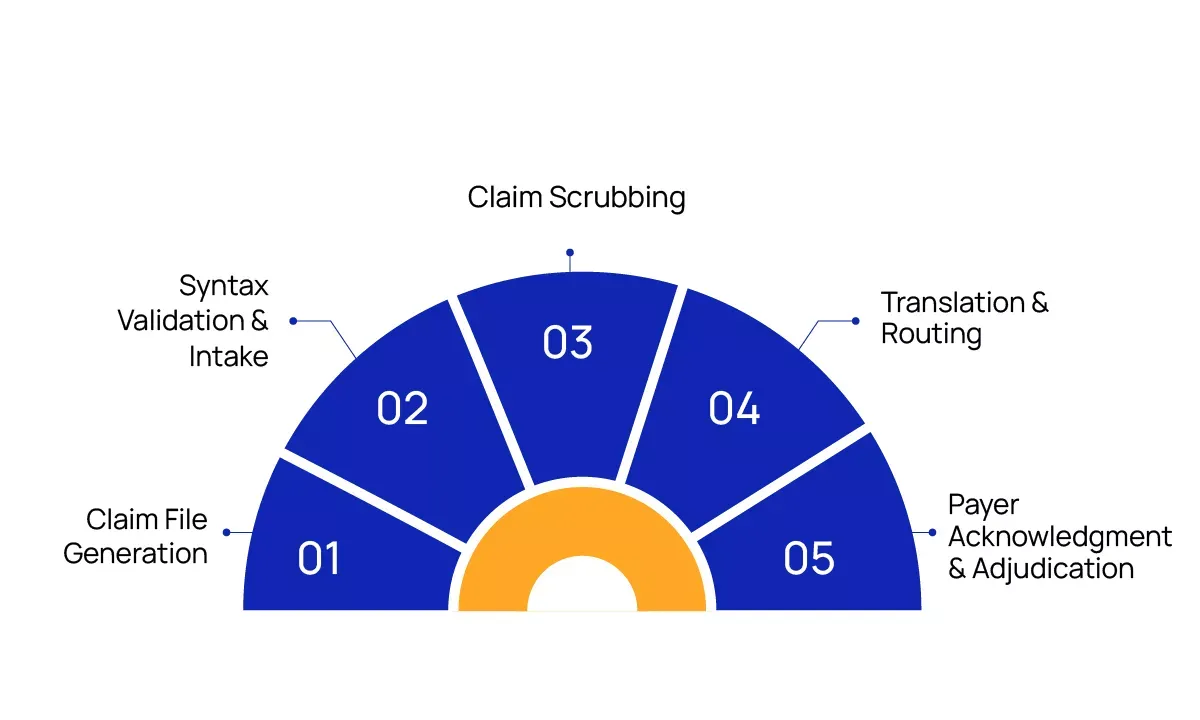
Once a claim leaves the practice management or EHR system, the following steps are carried out by the medical billing clearinghouse:
1. Claim File Generation
After billing professionals report and code the services rendered, the relevant practice management or EHR software creates an ASC X12N 837 file. This can be either professional, institutional, or dental.
The file contains all the relevant information, such as:
- Subscriber demographics
- Provider NPIs
- ICD-10-CM diagnoses
- CPT/HCPCS procedures
- Place of service (POS)
- Relevant modifiers
- Charges
All of this information is then reviewed through hierarchical loops and the necessary segments mandated by HIPAA.
2. Syntax Validation and Intake
Once the 837 file reaches the medical billing clearinghouse via a secure channel, the next step begins. The clearinghouse initially verifies the information or structure. In some cases, this information can include errors.
For instance, the ISA/GS headers may be flawed, or the dates mentioned are not within the accepted ranges. In such cases, the entire data can be rejected and returned using the TA1 interchange acknowledgment.
On the other hand, if the provided information is structurally valid, a 999-implementation acknowledgement is received.
3. Claim Scrubbing
In the next step, the medical billing clearinghouse begins a business-level edit for each claim. This includes checking for various elements, such as:
- NPI and taxonomy validity
- ICD-10-CM and CPT/HCPCS integrity
- Details of the coordination of benefits
- Payer-specific rules
If a claim fails, it is returned to the billing team along with the exact error location and specification.
Therefore, the details include the specific segment, loop, and element that is incorrect. This allows medical billers to rectify their mistakes before sharing the claim with the insurers, making a clearinghouse in medical billing a must.
4. Translation and Routing
After scrubbing, the team translates each claim, which involves the exact format of each destination payer.
Conversely, in the case of retail pharmacy transactions, NCPDP standards are followed instead of ASC X12 according to HSS guidelines. Therefore, the clearinghouse routing is handled per payer-specific transaction standards.
5. Payer Acknowledgment and Adjudication
Payers return a 277CA claim acknowledgment indicating whether the claim was accepted for adjudication or rejected at the front end. Depending on the response, these claims then go through the clearinghouse to the billing dashboard.
After adjudication, insurers return the 835 electronic remittance advice (ERA) files, allowing 276/277 transactions to be used to check the status of the claim.
Clearinghouse Rejection Codes & Prevention Best Practices
A clearinghouse rejection is not exactly a denial (like in the case of insurer rejection). Here, a rejection means the claim never qualified for the adjudication. Oftentimes, this can stem from data defects or structural inconsistencies.
Therefore, clearinghouse rejections can be reversed through claim rectification and resubmission without a formal appeal. Some of the most common triggers that may apply here include:
| Rejection Code | Description |
|---|---|
| Subscriber ID Error | Member ID does not match payer records. |
| Incorrect Payer ID | Claim sent to the wrong insurance payer. |
| NPI/Taxonomy Mismatch | Missing, invalid, or inconsistent provider identifiers. |
| Invalid/Outdated Codes | Use of deleted or inactive diagnosis/procedure codes. |
| Date Errors | Incorrect, future, or improperly formatted service dates. |
| Unbalanced Charges | Line item totals do not match the overall claim amount. |
Prevention Best Practices
Managing clearinghouse rejection codes is necessary for quicker reimbursement acceptance. The following are some of the best industry practices to streamline error rectification in case of a clearinghouse rejection in medical billing.
Coding Guidelines
Start by keeping the CPT, HCPCS, and ICD-10-CM code sets updated. Ideally, this should be done at every quarterly release. This means billing teams should also remove the deleted codes immediately.
Ensure Regular Monitoring and Standardize Workflows
Professionals should regularly check the clearinghouse dashboards and check for any missed or unread acknowledgments. Missing these details can result in bigger problems if not resolved in a timely manner.
Secondly, consistency is imperative for smoother and more effective clearinghouse processing. Therefore, it is necessary to standardize patient registration and insurance-capture workflows. This involves streamlining the:
- Payer IDs
- Member IDs
- Subscriber relationships
Run Real-Time Checks
Professionals should confirm the subscriber ID and payer on the date of service to avoid rejections in the next steps.
Fix Your System If Required
Many assume clearinghouse rejections apply only to individual claims, but they often indicate broader system or data issues.
Therefore, it is necessary to review every single rejection returned through acknowledgment transactions, such as 999 or 277CA, to identify and fix the primary reason for rejection. This way, your system becomes more efficient, and clearinghouse errors are inherently reduced.
Entrust Clearinghouse Enrollment to NeuraBill
Not every medical billing clearinghouse is built for every practice. The 2024 Change Healthcare cyberattack highlighted the risks of relying on a single clearinghouse vendor.
When evaluating a partnership service, look for:
- Payer coverage matching Medicare, Medicaid, and other commercial providers
- Documented HIPAA Security Rule compliance
- A signed Business Associate Agreement
- Knowledge of HIPAA syntax and payer companion guides
- Transparent reporting
- Clean integration with your EHR across relevant workflows
If you want reliable medical billing and coding services, including clearinghouse enrollments, our professionals can help you through every step of the process. Share your requirements, and we will fulfill them.
FAQs
Why do providers need a clearinghouse?
A medical billing clearinghouse converts billing data into an accurate, HIPAA-compliant claim format. The entity adheres to payer-specific rules, safely routing the electronic claims to applicable insurance payers.
Otherwise, the practice will need to build and maintain a separate EDI for every payer it bills. This leads to technical and administrative overhead, which complicates operations.
What type of information is submitted to the clearinghouse?
In most cases, a medical billing clearinghouse handles 837 claims and processes related HIPAA transactions. They also review eligibility requests, payer responses, and claim-status inquiries. In some cases, they also handle prior authorization requests and electronic remittance advice.
Are healthcare clearinghouses covered under HIPAA?
Yes, clearinghouses in healthcare are HIPAA-covered entities, according to the 45 CFR 160.103. They ensure that the digital sharing of health information is a standard, HIPAA-approved transaction.
Moreover, they act as business associates when they operate on behalf of a healthcare organization.