Coding precision is vital in billing, regardless of the procedure involved. Therefore, billing teams focus on accurate medical coding to ensure practitioners receive the reimbursements they deserve for their services promptly. However, it may be easier said than done when it comes to coding neurological procedures, including sleep studies.
One such example of sleep studies is represented by CPT code 95806. But what are sleep studies, and why do they even matter? Let’s find out.
Sleep Studies and Why They Matter
The graph below shows insufficient sleep trends in U.S. adults between 2013 and 2022.
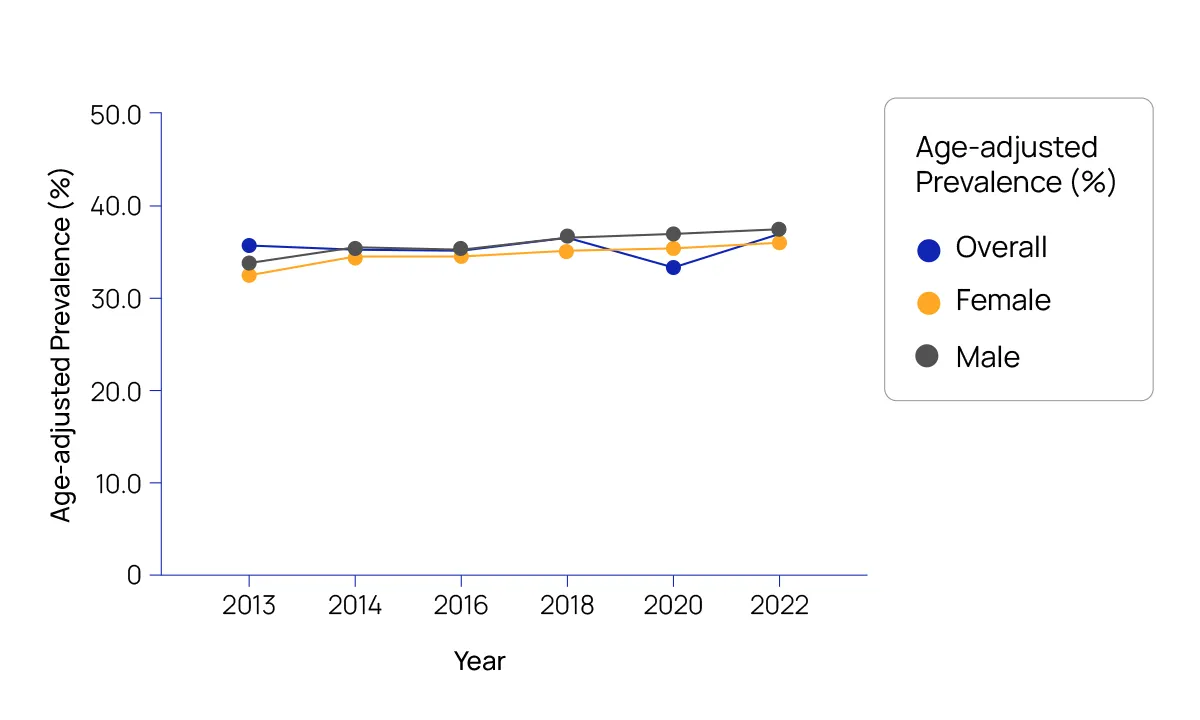
Source: CDC
According to estimations from HelpGuide, around 32.8 percent of adults do not get enough sleep, meaning about one-third of the adult population is sleep-deprived. Healthcare providers are tirelessly researching to address sleep-related issues and improve sleep quality for such individuals.
Sleep study CPT codes are designated codes assigned and maintained by the American Medical Association (AMA). These codes are used to report sleep studies for reimbursement purposes and generally range from 95782 to 95811, covering both attended and non-attended studies.
These studies may employ various techniques, such as polysomnography and home sleep apnea tests (HSAT).
With the help of the right CPT codes, professionals can categorize and charge payers for the studies. Some important factors that may distinguish sleep study CPT codes from one another include:
- How the procedure is conducted
- Type of monitoring involved
- Availability of the technologist
What is CPT Code 95806?
CPT code 95806 in particular applies to ‘Unattended Sleep Medicine Testing and Long-term EEG Procedures’. Here, “unattended” means that no technologist is present during the study.
Simply speaking, a wearable device with sensors monitors the patient’s body functions while they sleep at home or in a medical facility. Medical practitioners record and monitor the following patient parameters:
- Respiratory Effort
- Respiratory Airflow
- Oxygen Saturation
- Heart Rate
Healthcare practitioners test for obstructive sleep apnea (OSA), snoring, and body position through this study. Additionally, such sleep studies may also be helpful in post-operative monitoring and in detecting sleep disturbances among individuals with neuromuscular complications.
Scenarios Where CPT Code 95806 is Applicable
To further understand the applications of CPT code 95806, let’s examine some relevant medical scenarios.
High-Risk Occupation Screening
Consider the case of a 42-year-old airline pilot who complains of frequent microsleeps during flights. He also experiences morning headaches and partner-observed breathing pauses at night, hinting at potential obstructive sleep apnea.
This may conflict with the Federal Aviation Administration (FAA)’s safety standards for aviation personnel and could pose a risk to his career. Therefore, the medical practitioner prescribes a take-home device for the pilot to wear overnight. The study tracks the following:
- Oxygen drops
- Breathing pauses via a nasal pressure sensor
- Chest movement bands for effort
- Pulse rate to calculate the apnea-hypopnea index (AHI)
Data is recorded for at least 4 hours overnight. Findings reveal mild OSA with an AHI of 12, leading to weight loss, counseling, and a more comprehensive in-lab sleep study before resuming flying. The payer is billed using CPT code 95806.
Heart Failure Symptom Investigation
Imagine a 58-year-old patient with congestive heart failure who reports worsening nocturnal dyspnea, orthopnea, and daytime lethargy. These symptoms suggest coexisting sleep-disordered breathing and potential worsening of cardiac function due to oxygen desaturations.
At home, the patient wears a self-monitoring device to record:
- Heart rate (or ECG‑derived rhythm)
- Oxygen saturation
- Respiratory airflow
- Respiratory effort (e.g., thoracoabdominal movement)
After the results are in, the payer is billed for the unattended sleep study using CPT code 95806.
Endocrine Disorder Follow-Up
Consider the case of a 50-year-old female patient with newly diagnosed hypothyroidism. She arrives at the endocrinologist’s office with new-onset loud snoring and profound fatigue. Moreover, the patient is unresponsive to thyroid replacement, suggesting overlapping obstructive sleep apnea.
Therefore, the home testing kit’s sensors capture synchronized data on airflow limitation and monitor thoracoabdominal paradox for respiratory effort, desaturation events below 90%, and heart rate response over more than seven hours of sleep.
The clinicians diagnose moderate OSA with positional predominance, prompting mandibular advancement device trial alongside endocrine optimization. After the sleep study, the service is reported using CPT code 95806.
Applicable Modifiers for CPT Code 95806
Reporting CPT code 95806 without an appropriate modifier may reduce billing accuracy and increase the likelihood of claim denial. Therefore, it is necessary to learn about the applicable modifiers and the circumstances they apply to:
| Modifier | Purpose |
|---|---|
| Modifier 26 | Indicates the professional component of a sleep study. |
| Modifier 52 | Indicates reduced services during an unattended sleep study. |
| Modifier TC | Indicates the technical component of the sleep study. |
Modifier 26
Modifier 26 designates the professional component and is used when a physician or qualified provider performs the interpretation and reporting of the HSAT. Therefore, the technical component should be billed separately. This rule is explicitly recognized in HSAT coding guides for 95806.
Modifier 52
Modifier 52 represents reduced services and is appended when the procedure duration is shorter than the required duration. Simply put, if the HSAT records less than the typical 6 hours of data, modifier 52 may be appropriate for reporting for non-anesthetic procedures.
However, billing teams must support this reduction with documentation to justify the shortened duration.
Modifier TC
Modifier TC is used to report the technical component of a service. It indicates that an entity provided the equipment, setup, and data collection. But did not perform the interpretation. A physician or authorized provider was responsible for the professional component (interpretation & report).
CPT Code 95806 – Billing & Reimbursement Guidelines
Billing and reimbursement guidelines are essential for a successful and streamlined claims process. In the case of CPT 95806, here are the key points to remember:
Use the Code for HSAT Only
Medical billing professionals should use CPT code 95806 only for unattended or at-home sleep studies. Thus, it should not be used for standard or in-lab polysomnography.
Justify Medical Necessity
Medical necessity must be established before performing the procedure. This can be done in light of the patient’s symptoms, such as:
- Fatigue
- Snoring
- Headaches
- Discomfort
Also, ensure the use of appropriate ICD-10 codes and accurate clinical documentation.
Use the Correct Modifier
The correct modifier usage (when necessary) is another important guideline to remember. Incorrect usage could lead to claim denials or other complications.
Follow Payer-Specific Requirements
Ensuring you follow the latest requirements and guidelines set by the payer is of utmost importance. Each payer may have their coverage requirements, and meeting them is necessary.
Bottom Line
To summarize, CPT code 95806 refers to an unattended, at-home sleep study used to evaluate sleep-related conditions. The CPT code may be supplemented with up to three different modifiers, depending on the circumstances (see the modifier section above for more details).
95806 must be supported with accurate modifier usage, compliance with payer-specific requirements, and justification of medical necessity. However, if your practice does not have an in-house billing team to handle sleep study coding, you can outsource neurology billing services to professionals at NeuraBill.