Are you a team of 10 or fewer clinicians, and do you need medical billing solutions for your small practice? Running a small healthcare practice may seem easy, with more control over decisions, a cohesive work environment, and closer patient relationships. However, reality is quite different.
While nearly 51.8% of the physicians working in such practices are willing to do the extra work, financial problems can drain anyone. Billing is perhaps the biggest challenge for any organization, regardless of their size.
However, smaller practices have their own unique issues, heightened by a shortage of experienced staff. That’s why today we are here to explain why professional medical billing services are essential for your team.
Understanding How Medical Billing Works for Small Practices
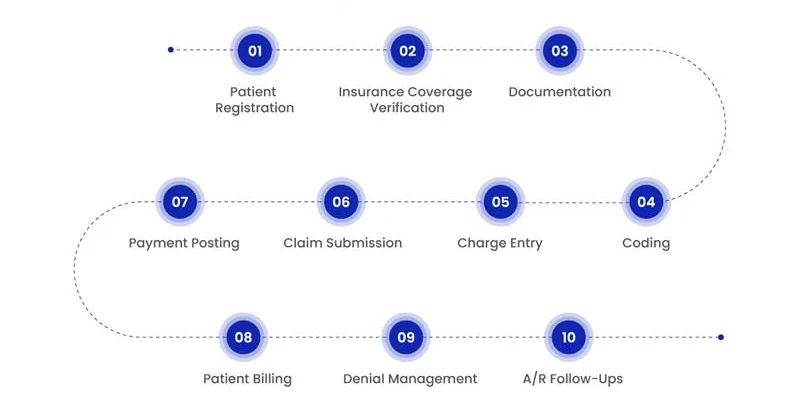
Before moving on to the billing options, you must first understand the step-by-step billing process of your own practice. Want to know why? Going through these steps will help you identify all the critical problems affecting your revenue.
Step 1: Patient Registration
This step is the foundation of the entire billing process. It includes collecting accurate and up-to-date patient information, such as name, contact number, address, and insurance details. Any error at this stage will affect the entire billing process and ultimately result in a denial.
Step 2: Insurance Coverage Verification
Insurance verification is another key step in medical billing. Before providing any service, you must verify the eligibility and benefits with the patient’s insurance provider. This will help you avoid treatment delays and obtain the required pre-authorizations.
Step 3: Documentation
After verifying a patient’s eligibility, you can provide the necessary services. However, you must document everything, including the reason for their visit, their medical history, and their current symptoms. This step also includes recording all services provided during the visit and sets the stage for the next and most important step in medical billing.
Step 4: Coding
Coding occurs after a patient’s visit. It is the most challenging part for any organization, including small healthcare practices. During this stage, you must assign appropriate diagnostic or procedural codes based on the documentation of the services you provided to the patient.
Accurate coding depends on one thing: updated information of all the coding systems, including CPT, HCPCS, and ICD.
Step 5: Charge Entry
Next, every practice has to enter the appropriate fees to the corresponding service codes in its billing system. This charge entry is based on the practice’s fee schedule.
Step 6: Claim Submission
Claim submission is the most obvious step after charge entry. You can file your claims either through a clearinghouse or submit them directly to the insurance company. Now, this may feel like a final step, but medical billing doesn’t end with you submitting claims to appropriate payers.
Step 7: Payment Posting
The insurance companies approve your claims after reviewing them thoroughly. They then reimburse the amount for your services. These payments are reconciled with expected reimbursements and then recorded into the billing system.
Step 8: Patient Billing
Finally, send out clear, detailed statements to your patients for any remaining balances. Keep in mind that patient billing must always include convenient payment options.
Step 9: Denial Management
For denied claims, identify potential reasons and correct them. You must resubmit the corrected claims on time to avoid further delays and hard rejections.
Step 10: A/R Follow-Ups
To maintain a steady cash flow, successful practices also keep track of their unpaid claims and outstanding balances. They also take frequent follow-ups with insurers to avoid revenue leakages.
Medical Billing Struggles for Small Healthcare Practices
Medical billing is quite frustrating for many due to the ever-changing rules and regulations. A single mistake at any stage can affect all the consequent steps, disrupting the entire billing cycle. So, which billing challenges give small healthcare practices the toughest time? Let’s find out!
Shortage of Experienced Billing Staff
Small healthcare practices lack manpower the most. Hence, they often struggle to maintain a balance between clinical and administrative duties. Since most of their clinical staff handle billing tasks, they are often overworked and burnt out. As a result, they make common billing mistakes, and consequently, the practice faces high denials.
Keeping Up with the Changing Billing Rules
This is a common billing challenge for all types of healthcare organisations. However, billing rules and policy changes affect small healthcare practices the most. They don’t have the time or enough human resources to keep up with these changes. As a result, they experience denials.
Remaining Compliant
Many small healthcare practices don’t pay special attention to information security. Hence, they fail to secure their patients’ information and face legal issues.
Maintaining Operational Efficiency
All the other billing challenges mentioned above lead to financial instability. Therefore, many smaller healthcare organizations struggling with these issues fail to maintain their operations.
Building Patient Trust
Billing issues can keep anyone occupied. But they become even more problematic when they take your time and attention away from your patients. This creates a sense of dissatisfaction among patients, making it impossible for professionals to build a strong relationship with them.
In-house vs. Outsourced Medical Billing Services for Small Practices
Efficient medical billing is the backbone of financially stable practices. That’s why you cannot take any shortcuts to achieve desirable outcomes. In-house billing vs outsourcing is a common debate among healthcare organizations. While many small practices tend to manage everything in-house, many outsource their operations to cut costs. So, what is the best option for your practice? Let’s do a brief cost-benefit analysis:
| Key Factors | Outsourced Medical Billing | In-House Medical Billing |
|---|---|---|
| Initial Costs | Low (outsourcing allows you to save up to 40% of costs than in-house billing) | High (Requires investment in billing software, staff hiring, and training) |
| Maintenance | Low (Billing companies charge 4% to 9% of your collected monthly revenue) | Requires more money due to monthly salaries, software subscriptions, and regular training |
| First-Past Rate | Excellent first pass payment rate (80% on average) | Low first pass payment rates (68%) due to continuous mistakes |
| Error Rates & Denials | Significantly lower than in-house billing (below 5%) | Around 10 to 15% of healthcare claims get denied. |
| Administrative Tasks | Billing companies handle these so there is no burden on your team | In-house billing requires a dedicated team for managing these tasks |
| Accuracy & Compliance | Guaranteed (Billing companies stay updated with coding and payer regulations) | Depends on your billing team’s expertise |
As you can see, outsourcing is the most cost-effective option, especially for a team of 10 or fewer clinicians. So, which factors should you consider when choosing a billing partner for your practice?
Choosing a Medical Billing Partner for Your Small Practice
You should consider the following things before putting your trust in any company:
Small Practice-Specific Expertise
Small clinics like yours have unique needs. That’s why it is common knowledge that a billing company that primarily works with large healthcare organizations will not be suitable for your billing needs.
Hence, the first factor to consider when choosing your billing partner is to understand their customer base. In simple terms, look for professionals who expertly deal with small practice workflows.
Transparent Pricing
Price is another deal breaker. You should know what you are paying for. Many billing companies seem perfect on paper, but they are not clear about their pricing. One common thing about all medical billers is that they charge a percentage of collections or a monthly flat rate.
However, only a few companies are transparent about the actual figure. Our advice is to avoid companies with vague terms and many hidden charges. In short, choose an affordable billing partner with an easy-to-understand pricing model.
Customized RCM Solutions
As we said earlier, your requirements are unique. Therefore, prioritize a company that offers customized solutions according to your needs and specialty. This includes tailored comprehensive revenue cycle management services, including insurance verification, claim submission and tracking, and payment posting.
HIPAA Compliant Processes
Data security is mandatory for all healthcare organizations. Hence, your chosen billing partner should have compliant billing processes with tight security controls to protect your patients’ sensitive information. They should also have a strict payer-specific compliance policy in place.
Best Medical Billing Softwares for Small Practices
Want to improve your practice’s efficiency? Automate your repetitive tasks with reliable software. The global medical billing software market size is growing at a CAGR of 10.2%, with North America holding the largest market share. Many healthcare organisations in the U.S. are shifting towards digitization to improve their financial performance.
If you also have the budget, we recommend choosing specialized software to reduce your denials. The key is to look for a platform with EHR integration, a user-friendly interface, real-time eligibility checks, and claim scrubbing. Need our help? Here are the top five medical billing software for small practices:
| S. No | Top Billing Software | Key Features |
|---|---|---|
| 1 | Tebra (Kareo) | – Automated end-to-end workflows- Comprehensive Claim Management- Integrated Patient Payments- Automation Add-Ons |
| 2 | Medesk | – Automated Medical Billing- Real-time Sync with Xero (an Accounting Software)- Built with security controls that support GDPR requirements- Automated Financial Reporting |
| 3 | AdvancedMD | – Personalized Bundles- Centralized Billing- Intelligent Claim Scrubber- Specialty-Specific Solutions |
| 4 | DrChrono by EverHealth | – Integrated Medical Billing- Intelligent Reporting Tools- Continuous Development of Advanced Billing Features- Mobile-Friendly Platform |
| 5 | PracticeSuite | – AI-Powered Tools- Scalable Platform- Integrated RCM Solutions- Flexible Claim Management |
Medical Billing Services for Small Practices by NeuraBill
Anyone running a healthcare practice can understand that medical billing is anything but simple. Each organization faces denials due to unique reasons and mistakes. The process is especially difficult for small practices due to their staffing shortages. That’s why at NeuraBill, we offer customized solutions to small and independent practices and solo practitioners.
With years of specialty-specific expertise, we can handle your billing problems and help improve your cash flow. Our defining quality is that we can work with all billing software, including the popular platforms mentioned in the above section. Want to know what we offer?
Our key billing solutions include: