
Did you ever think that a simple agreement paper could make the billing process easier for both healthcare providers and patients? Yes, there is an agreement that permits a healthcare practitioner to be paid directly by an insurance company for performed services.
Patients allow the provider to use an Assignment of Benefits (AOB) form to obtain payment directly from the payer since they typically prefer not to get involved in the intricacies of out-of-pocket patient payments.
An AOB in medical billing is a legal document that the patient signs, authorizing the insurance payer to pay the physician, hospital, clinic, or other healthcare provider directly.
In practices that use medical billing systems, this one document is essential to maintaining both revenue and the administrative staff’s sanity. Read on to discover how this form simplifies billing, how the process works, and why medical practices increasingly require it.
Significance of AOB in Medical Billing
AOB in medical billing is not just another step. It has the potential to alter your entire revenue cycle. It is a contract whereby patients grant healthcare providers the legal right to file insurance claims and receive payments directly.
Under this arrangement, patients no longer have to first pay out of pocket and later handle complicated insurance paperwork. Moreover, it enables providers to get paid on schedule.
But to your surprise, it not only makes life easy for healthcare practices and patients but also has significant positive effects on insurance payers. Let’s discuss the importance of this form for each of them:
Benefit for Patients
- It reduces financial stress.
- Saves patients from complex insurance paperwork.
- Patients are usually only responsible for deductibles, copayments, or non-covered services.
- No upfront payment stress.
- Patients can receive timely medical care.
Benefits for Healthcare Practitioners
- Maintenance of steady cash flow.
- Efficient revenue cycle management.
- Allows direct billing to insurance companies.
- Faster payment collection.
- Decreases administrative burdens.
- Lowers the risk of unpaid bills.
- Improves overall financial stability for the practice.
Benefits for Insurers
- Simplifies the healthcare payment process.
- Ensures timely claim submission.
- Reduces billing errors.
- Clear communication between the payer and the provider.
- Approved claims are paid accurately to authorized healthcare providers.
- Efficient claims management system.
- Reduces risk of incorrect reimbursements.
Components of an AOB Form
The following are the components that must be included in the form to ensure clarity, compliance, and appropriate claim processing.
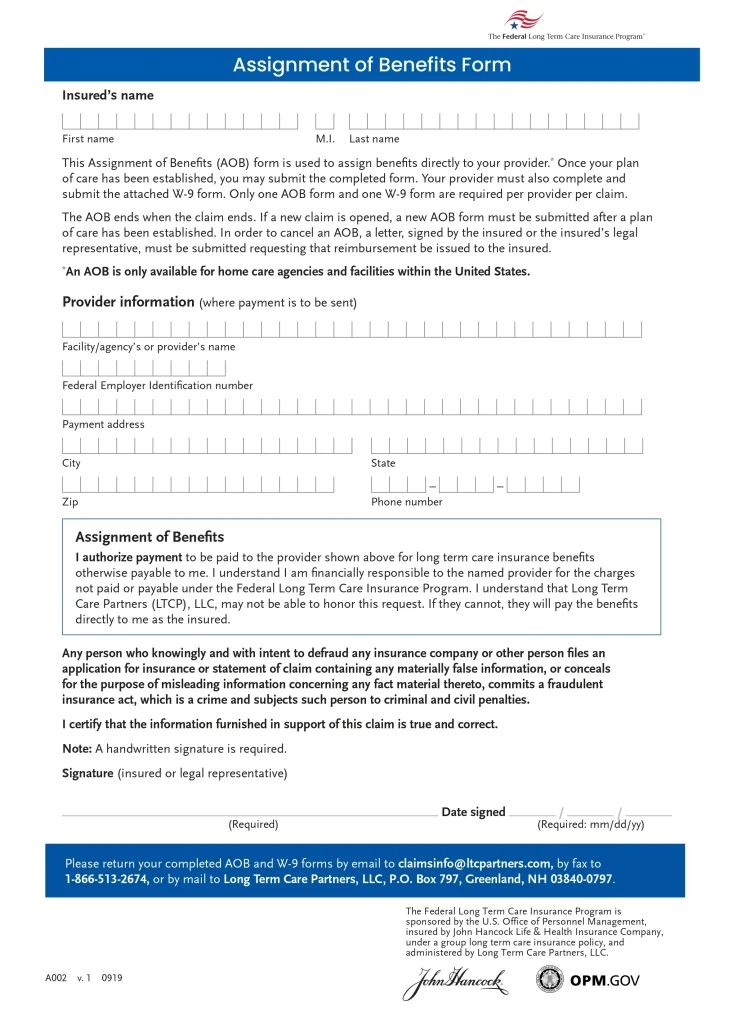
Source: FLTCIP.gov
Patient Information
The form must include the basic information, such as the patient’s full name, birthdate, address, and phone number.
Provider Information
The AOB form must also include details of the rendering provider, such as the facility or practitioner’s name, identification number, complete address along with zip code, and contact number.
Insurance Information
This section must contain the insurance payer’s information, such as the name of the insurance company, plan type, policy number, and group number. This makes it easier to link the claim to the appropriate insurance coverage.
Assignment of Benefits
This clause makes it quite clear that the patient should not receive payment. It legally gives the insurance company permission to pay the healthcare provider directly for services performed.
Authorization to Release
This part enables the healthcare provider to give the insurance company the medical records and billing data that are required for processing and paying claims.
Signature and Date
Lastly, the AOB form will be valid with the patient’s (or legal guardian’s) signature and date. Depending on the rules, witness or provider signatures may also be required on some forms.
Assignment of Benefits (AOB) Process Workflow
The process is slightly different when a patient signs the AOB form. Hence, here is an explanation chart that describes how AOB in medical billing typically works.
| Patient Signature: Patient signs the form at the provider’s office. By signing, the patient gives the provider permission to access the insurance and medical data required for processing claims, as well as to collect insurance payments directly. |
↓
| Insurance Verification: The healthcare professional confirms the patient’s insurance eligibility and benefits after obtaining the signed form. |
↓
| Claim Submission to Insurer: The provider submits the insurance claim and any supporting documentation to the payer. |
↓
| Insurer Processes Claims: The insurance payer examines the claim to identify policy compliance, coverage, and medical necessity. The conditions of the insurance policy are then used to determine whether the claim is accepted, rejected, or paid in part. |
↓
| Explanation of Benefits (EOB): When the insurance company pays the healthcare provider, an Explanation of Benefits (EOB) is sent to the patient to show exactly how the payment was processed. |
Key Benefits of AOB in Medical Billing
- The ability for insurance payers to pay healthcare providers directly is one of the main advantages of AOB.
- The agreement allows the practice to receive the insurance payment directly, reducing payment delays because the wait time for the patient to transfer the funds is eliminated.
- Practices can maintain a more seamless revenue cycle by receiving direct payment from insurance payers.
- Direct management of the payment process, communication with the payer, and submission of claims are all possible for the provider.
- Patients are not confused anymore because the billing process is more structured.
- Patients are typically only accountable for their portion, which includes non-covered therapies, co-pays, deductibles, and coinsurance.
Final Thoughts
To sum up, Assignment of Benefits (AOB) is essential for medical billing in the current healthcare system. It ensures faster insurance reimbursements, lessens the administrative burden on patients, and improves overall revenue cycle management for healthcare providers.
AOB in medical billing is a strategic process that involves the patient signing the agreement and the payer releasing payment once all necessary stages are complete.
Even with an AOB, some healthcare providers still struggle with medical billing. In that case, we recommend professional medical billing and coding services to streamline financial operations. Expert billers can take on intricate tasks and enhance the revenue cycle with high-quality and round-the-clock support.
Frequently Asked Questions
What is the difference between AOB and EOB?
An AOB is a document that the patient signs that permits direct payment to the provider. An EOB is a payment summary that the insurance payer sends to the patient detailing what was paid and what the patient may still owe.
What are some examples of AOB usage?
Suppose before receiving services for knee replacement surgery, the patient fills out an AOB form in a hospital. Rather than collecting the amount from the patient in advance, the physician submits the claim to the insurance company for reimbursement.
What will happen if AOB is not signed?
The healthcare provider might not be legally permitted to accept payment directly from the insurance company if the form is not signed.
What are the cons of AOB?
This agreement may increase the chances of fraud or unauthorized use if the provider mismanages claims. Choosing reputable providers mitigates these risks.